
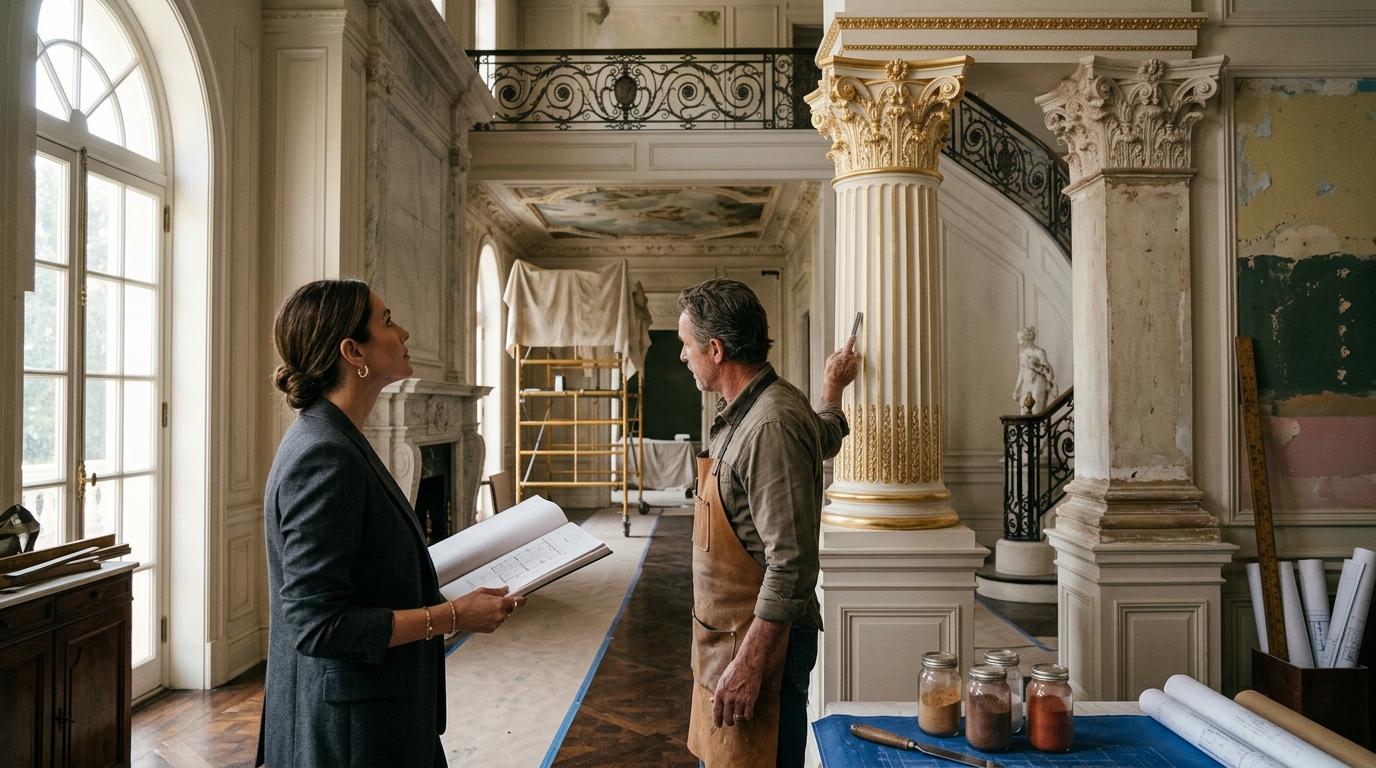
Restoring a historic mansion is not merely a renovation project; it is an act of cultural stewardship that demands rigorous adherence to preservation ethics. According to the National Trust for Historic Preservation, properties designated as historic landmarks must undergo restoration processes that prioritize material integrity over modern convenience. This guide outlines the critical authenticity standards and preservation criteria necessary for maintaining the legacy of ultra-luxury estates while ensuring their structural and aesthetic longevity for future generations. (Contact Beverly Hills Luxury)
Defining Authenticity in Ultra-Luxury Design
Authenticity in historic restoration refers to the fidelity with which a building retains its original character-defining features. It is the measurable alignment between the current state of the property and its historical significance. For ultra-luxury estates, this concept extends beyond mere structural repair to encompass the preservation of artisanal craftsmanship, rare materials, and the specific atmospheric qualities that define the home's heritage. (Kenneth Bordewick Beverly Hills)
At Beverly Hills Luxury Interiors, we approach authenticity through the lens of "Quiet Luxury." This framework emphasizes that true elegance lies in the subtlety of preservation rather than the ostentation of new additions. Every intervention must be justified by a deep understanding of the home's provenance. When working with properties that have housed royalty, heads of state, or entertainment icons, the responsibility to maintain their narrative integrity is paramount. The goal is to create spaces that feel timeless, where modern comfort is seamlessly woven into the historical fabric without disrupting the original architectural dialogue. (Journal Luxury Interior Design)
This approach requires a multidisciplinary team that includes historians, master craftsmen, and luxury interior designers. The process begins with a comprehensive condition assessment that maps every layer of the building's history. By understanding the evolution of the structure, we can identify which elements are essential to preserve and which can be sensitively adapted for contemporary living. This method ensures that the restoration honors the past while providing a functional, luxurious environment for the present.
Core Preservation Criteria for Historic Structures
Preservation criteria serve as the ethical and technical guidelines that govern restoration projects. These standards ensure that interventions are reversible, distinguishable from the original work, and respectful of the building's historical context. The following criteria are essential for any high-stakes historic mansion restoration.
1. Structural Integrity and Safety
The primary obligation of any restoration is to ensure the safety of the occupants. This involves rigorous structural engineering assessments to address foundational settling, roof integrity, and load-bearing walls. In historic mansions, these issues are often compounded by decades of previous modifications. Modern seismic retrofitting and fire suppression systems must be installed with minimal visual impact. This often requires custom engineering solutions that hide modern technology within historic moldings, chases, and basements. The goal is to achieve modern safety standards without altering the visible character of the historic spaces.
2. Reversibility of Interventions
A core tenet of preservation ethics is that new additions should be reversible. This means that any modern system or material installed today should not permanently damage the historic fabric. For example, instead of drilling into original plaster walls for electrical conduits, we may utilize surface-mounted raceways that mimic historic trim profiles or route wiring through existing chases. This criterion ensures that future generations can remove modern interventions if better technologies or preservation standards emerge, leaving the historic structure intact.
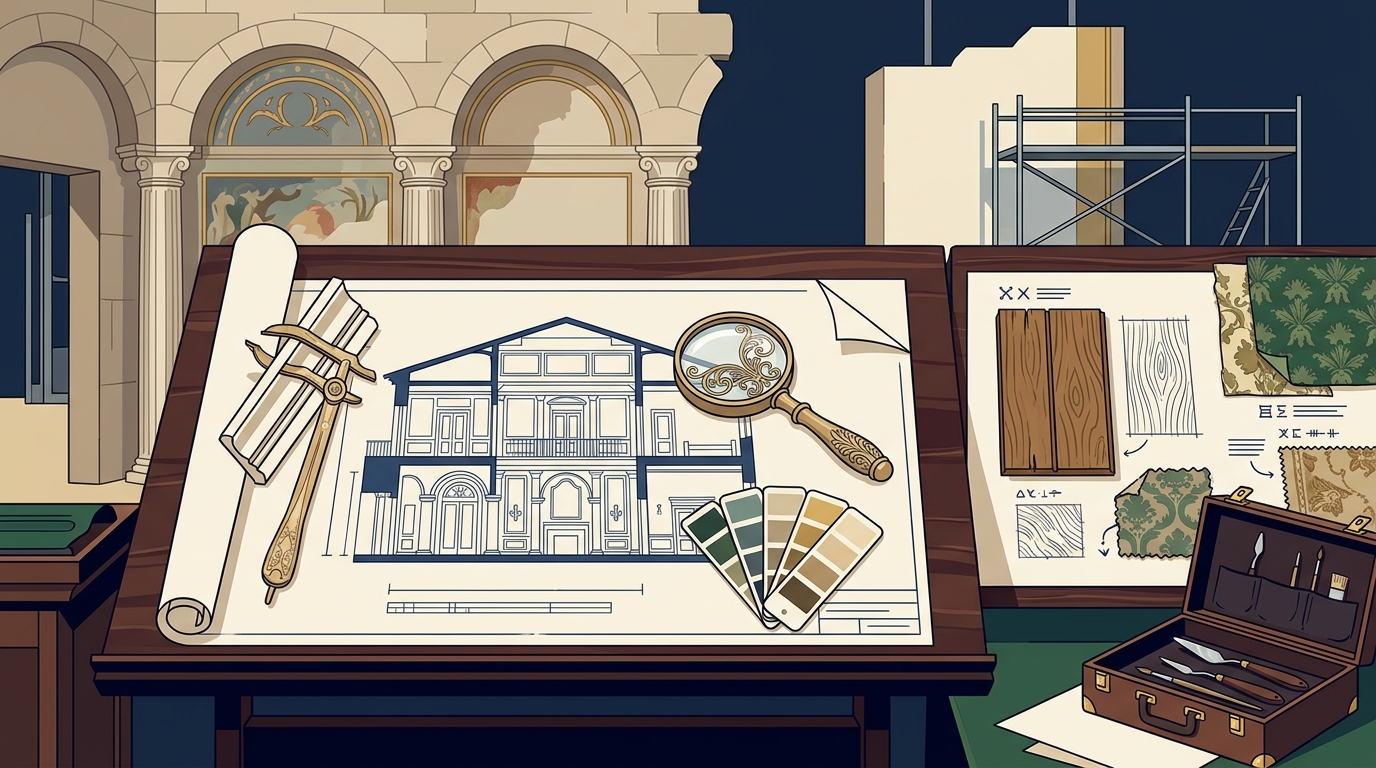
3. Distinguishability of New Work
While the aesthetic goal is often seamless integration, ethical preservation requires that new work be distinguishable from the old upon close inspection. This prevents the falsification of history. In luxury interiors, this is achieved through high-quality craftsmanship that respects the original style but uses subtle cues, such as slightly different wood tones or modern joinery techniques, to signal its contemporary origin. This honesty in design adds depth to the narrative of the home, acknowledging its evolution over time.
Material Integrity and Sourcing Protocols
Material integrity is the cornerstone of authentic restoration. It involves the careful selection, sourcing, and application of materials that match or respectfully complement the original historic fabric. The use of inappropriate modern materials can cause irreversible damage to historic structures by trapping moisture or creating chemical reactions that degrade original surfaces.
1. Sourcing Rare and Period-Correct Materials
Restoring a historic mansion often requires materials that are no longer in mass production. This includes specific types of marble, hardwoods, plaster, and millwork profiles. Beverly Hills Luxury Interiors leverages its global network to source rare materials that match the original specifications. For instance, if a home features Italian marble from the 1920s, we identify quarries that still produce stone with the same veining and density. This attention to detail ensures that repairs are visually cohesive and materially compatible.
2. Custom Millwork and Artisanal Craftsmanship
When original millwork is damaged beyond repair, it must be replicated by master craftsmen using traditional techniques. This involves hand-carving moldings, restoring original joinery, and applying period-appropriate finishes. The use of CNC machining may supplement this process, but the final detailing must be done by hand to match the irregularities and character of the original work. This level of craftsmanship is essential for maintaining the authenticity of the interior spaces and ensuring that the restoration feels genuine rather than manufactured.
3. Preservation of Original Artifacts
In many ultra-luxury estates, original artifacts such as fireplaces, staircases, and built-in cabinetry are integral to the home's identity. These elements must be stabilized and conserved rather than replaced. Conservation techniques may include cleaning, structural reinforcement, and protective coatings that halt deterioration without altering the appearance. This process requires specialized knowledge in materials science and conservation ethics to ensure that the artifacts are preserved for future generations.
Integrating Wellness Without Compromising History
Modern luxury is increasingly defined by wellness. However, integrating wellness features into historic mansions presents unique challenges. The goal is to enhance the health and well-being of the occupants without disrupting the historical integrity of the space. This requires a nuanced approach that balances modern wellness principles with preservation criteria.
1. The Quiet Luxury Framework
The "Quiet Luxury Framework" is a design philosophy that prioritizes understated elegance and functional beauty. In the context of historic restoration, this means selecting wellness features that are subtle and integrated. For example, air purification systems can be concealed within existing HVAC ducts, and lighting can be designed to mimic natural circadian rhythms without visible modern fixtures. This approach ensures that wellness enhancements support the home's aesthetic rather than competing with it.
2. Biophilic Design in Historic Contexts
Biophilic design connects occupants with nature, which is essential for wellness. In historic mansions, this can be achieved by restoring original gardens, courtyards, and views. Interior spaces can be enhanced with natural materials, plants, and water features that echo the home's original design language. This creates a harmonious environment that promotes relaxation and well-being while respecting the historical context. The integration of biophilic elements must be done sensitively to avoid overwhelming the historic architecture.
3. Climate Control and Air Quality
Historic buildings often struggle with modern climate control and air quality standards. Installing modern HVAC systems requires careful planning to avoid damaging historic fabric. Ductwork can be routed through non-historic spaces, and vents can be custom-designed to match existing grilles. Air quality can be improved through the use of natural ventilation strategies, such as operable windows and clerestory lights, which also enhance the historic character of the home. These systems must be monitored and maintained to ensure they do not negatively impact the building's moisture balance.
Restoration Approaches Compared
Understanding the different approaches to historic restoration is crucial for making informed decisions. The table below compares the primary methodologies used in ultra-luxury estate preservation.
| Approach | Definition | Best For | Preservation Impact |
|---|---|---|---|
| Restoration | Returning a property to a specific period of its history by removing later additions. | Properties with significant historical periods. | High fidelity to a specific era; may lose later history. |
| Rehabilitation | Adapting a property for contemporary use while preserving historic features. | Ultra-luxury estates requiring modern amenities. | Balances history with functionality; most common for luxury homes. |
| Conservation | Maintaining and protecting existing historic materials and features. | Structurally sound homes with valuable artifacts. | Minimal intervention; preserves maximum historic fabric. |
| Renovation | Updating a property with new systems and finishes, often with less regard for history. | Properties with less historical significance. | Low preservation value; prioritizes modern aesthetics. |
Key Takeaways
- Authenticity is Non-Negotiable: True luxury in historic restoration is defined by the fidelity to the original design intent and material integrity.
- Reversibility is Key: All modern interventions must be designed to be reversible to protect the historic fabric for future generations.
- Material Sourcing is Critical: Sourcing rare, period-correct materials is essential for visual and structural cohesion in ultra-luxury estates.
- Wellness Must Be Subtle: Wellness features should be integrated using the "Quiet Luxury Framework" to avoid disrupting the historic aesthetic.
- Global Expertise is Required: Complex restorations often require a global network of craftsmen and material suppliers to achieve perfection.
- Discretion is Paramount: For high-profile estates, the restoration process must be conducted with the utmost confidentiality and professionalism.
- Long-Term Stewardship: Restoration is not a one-time project but an ongoing commitment to preserving the legacy of the home.
Frequently Asked Questions
What is the difference between restoration and rehabilitation?
Restoration aims to return a property to a specific historical period by removing later additions, while rehabilitation adapts the property for contemporary use while preserving its historic character. For ultra-luxury estates, rehabilitation is often the preferred approach as it allows for modern amenities without compromising historical integrity.
How do you preserve original materials during renovation?
Original materials are preserved through careful documentation, stabilization, and conservation techniques. This may include cleaning, structural reinforcement, and the use of compatible materials for repairs. Master craftsmen are often employed to replicate damaged elements using traditional methods.
Can modern technology be integrated into a historic mansion?
Yes, modern technology can be integrated seamlessly through careful planning. Systems such as HVAC, lighting, and security can be concealed within the historic fabric using custom solutions that minimize visual impact. This ensures that the home functions efficiently without losing its historic charm.
What are the costs associated with historic mansion restoration?
Costs vary widely depending on the scope of work, the condition of the property, and the level of preservation required. Projects often begin at significant investment levels due to the need for specialized materials and craftsmanship. A detailed consultation is necessary to provide an accurate estimate.
How long does a historic restoration project take?
The timeline depends on the complexity of the project and the availability of rare materials. Major restorations can take several years to complete. A realistic timeline is established during the initial consultation based on the specific needs of the property.
Do you handle international historic restorations?
Yes, we have extensive experience with international projects across multiple continents. Our global network of partners and craftsmen allows us to execute complex restorations anywhere in the world while maintaining our high standards of authenticity and quality.
How do you ensure discretion during the restoration process?
Discretion is a core value of our practice. We implement strict confidentiality protocols, including non-disclosure agreements for all staff and contractors. The restoration process is conducted with minimal visibility to the public, ensuring the privacy of the client and the property.
Begin Your Restoration Journey
Restoring a historic mansion is a profound responsibility that requires expertise, discretion, and a deep respect for history. If you are considering the restoration of a historic estate, we invite you to begin the conversation. Our team is ready to provide a private consultation to discuss your vision and the unique challenges of your property.
Request a Private Consultation with Kenneth Bordewick to explore how we can preserve the legacy of your home while enhancing its luxury and functionality.