
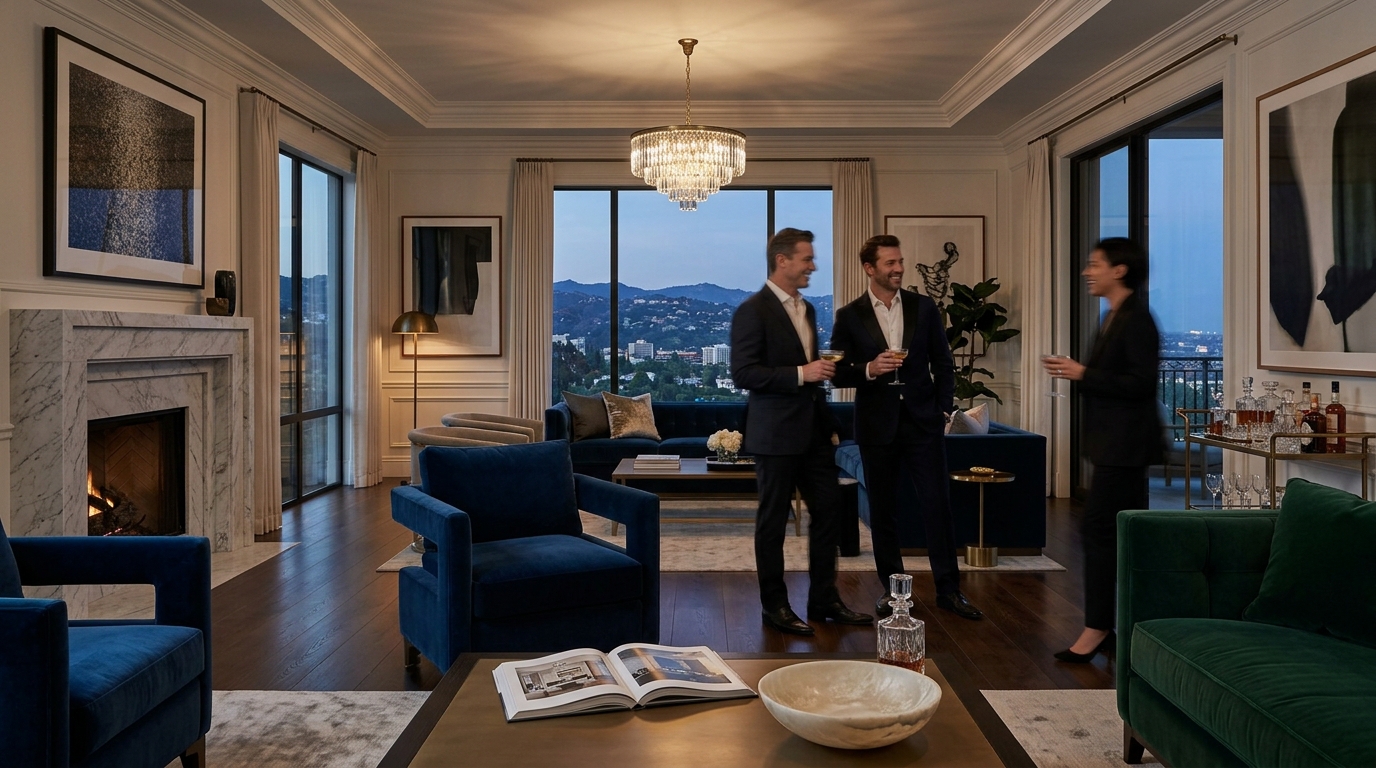
Hollywood glamour and American elegance are often described as if they were opposing ideas: one theatrical and high-impact, the other composed and enduring. In a well-resolved luxury interior, however, they operate as complementary design languages. Hollywood glamour supplies atmosphere, confidence, and cinematic contrast. American elegance contributes proportion, symmetry, architectural discipline, and a sense of permanence.
The result is not a room filled with indiscriminate shine or period decoration. It is a highly edited environment in which materials, lighting, furniture scale, and architectural detail work together to create a memorable experience. For private residences, estates, penthouses, and other exceptional properties, the style can provide the visual drama of a grand hotel while preserving the comfort and individuality of a personal home. Request a Private Consultation.
What Is Hollywood Glamour and American Elegance?
Hollywood glamour in interior design is an atmosphere of polished drama. It may include reflective surfaces, sculptural lighting, rich upholstery, strong color contrast, and carefully positioned decorative accents. Its purpose is to shape how a room feels, not simply how it looks. A glamorous interior should create arrival, anticipation, intimacy, and visual pleasure.
American elegance is more architectural and measured. It draws on classical traditions while adapting them to the scale and openness of American homes. Symmetrical furniture arrangements, centered fireplaces, substantial millwork, refined textiles, and lasting materials establish a calm visual order. Traditional interiors commonly use symmetry, architectural trim, chandeliers, bookcases, neutral foundations, and fabrics such as wool, velvet, and cotton. ([architecturaldigest.com](https://www.architecturaldigest.com/story/traditional-interior-design-101?utm_source=openai))
When the two approaches are combined, the design becomes both expressive and controlled. A lacquered console may introduce glamour, while a properly scaled paneled wall gives it architectural authority. A crystal or metal chandelier can become the focal point, while tailored upholstery and a disciplined room axis keep the composition from feeling excessive.
A practical definition
Hollywood glamour is the emotional effect; American elegance is the underlying structure. The first attracts the eye and creates mood. The second ensures that the room remains balanced, functional, and timeless.
The Hollywood Connection: From Golden-Age Drama to Residential Luxury
The style’s historical identity is closely associated with Southern California and the Golden Era of Hollywood. Hollywood Regency architecture and interiors became especially prominent from the early 1930s through the postwar period, combining Regency and Neoclassical references with modern, Art Deco, and Moderne influences. The Los Angeles City Planning Department describes the style as strongly connected to the entertainment industry, movie-star culture, and the period’s ideals of glamour and sophistication. ([planning.lacity.gov](https://planning.lacity.gov/plndoc/Staff_Reports/2023/09-21-2023/CHC_2023_5913_HCM_250_N_Norton_Avenue_UC.pdf?utm_source=openai))
Beverly Hills was an important setting for this evolution. The Los Angeles Conservancy notes that Beverly Hills became closely associated with Hollywood Regency during the 1930s, while designer John Elgin Woolf helped popularize glamorous mansard-roof residences and a refined architectural vocabulary for prominent Southern California clients in the 1940s and afterward. ([laconservancy.org](https://www.laconservancy.org/wp-content/uploads/2022/10/Beverly-Hills-Historic-Resources-Survey-update-and-multi-family-residential-properties-2004.pdf?utm_source=openai))
The historic Max Factor Building in Hollywood provides another useful illustration of the era’s visual language. Designed by S. Charles Lee in a Hollywood Regency Art Deco style, the building incorporated lavish marble, chandeliers, trompe l’oeil, and gold and silver leafing—features that demonstrate how theatrical presentation, luxury materials, and architectural detailing were combined. ([thehollywoodmuseum.com](https://thehollywoodmuseum.com/about/our-history-vision/?utm_source=openai))
Contemporary luxury design does not need to reproduce a 1930s film set. Instead, it can interpret the period’s most enduring ideas: dramatic framing, flattering illumination, strong silhouettes, sophisticated contrast, and a sense that every room has a point of view.
The Design Principles Behind the Look
1. Begin with proportion, not decoration
Luxury is immediately weakened when furniture is too small for the room, lighting is undersized, or architectural details are out of scale. Before selecting finishes, establish the room’s centerlines, focal points, circulation paths, ceiling height, and relationship to adjacent spaces. In a formal living room, for example, the rug, central light fixture, fireplace, and primary seating arrangement should relate to the same visual axis wherever the architecture allows.
American elegance depends on this sense of order. Symmetry often works through pairs—chairs facing one another, lamps flanking a console, or artwork balanced across a fireplace—but it does not require mechanical duplication. Visual weight, height, color, and texture can create balance even when individual pieces are different.
2. Use contrast with restraint
Hollywood glamour needs contrast to create energy. Consider ivory boucle against dark stained oak, polished nickel against smoked glass, or deep emerald velvet against warm limestone. The most successful interiors typically establish one dominant contrast and repeat it in smaller, quieter details. Too many competing contrasts can make an interior appear themed rather than bespoke.
3. Build a tonal foundation
A controlled base palette allows exceptional materials and art to receive attention. Cream, parchment, taupe, charcoal, warm white, espresso, muted blue, and soft gray can provide a sophisticated foundation. Jewel tones—including sapphire, emerald, garnet, and amethyst—are most effective as upholstery, drapery, art, or accent furniture rather than as unrelated color notes scattered throughout the home.
4. Layer tactile experiences
Visual luxury is only one part of a successful residence. The hand should encounter variation: the softness of silk or velvet, the grain of figured wood, the coolness of stone, the weight of a wool rug, and the subtle irregularity of a hand-finished metal. Layering smooth, lustrous, matte, woven, and natural surfaces prevents a formal interior from feeling sterile.
5. Edit the room until every object has a role
The most sophisticated glamorous rooms are rarely the most crowded. A monumental mirror, an important sculpture, a pair of custom tables, or one exceptional textile may create more impact than a collection of unrelated accessories. Each object should contribute to scale, rhythm, function, history, or emotion.
Materials, Finishes, and Bespoke Craftsmanship
Materials give Hollywood glamour and American elegance their credibility. In a high-end interior, the question is not simply whether a surface appears expensive on installation day. It is whether the material has depth, performs appropriately, can be repaired or refinished, and will develop character over time.
Stone and marble
Marble can provide the luminous, high-contrast quality associated with glamour, particularly when used for fireplaces, entry floors, bar fronts, bathrooms, or sculptural tables. Bookmatching can create a dramatic focal point, while honed or leathered finishes offer a quieter and more tactile interpretation. The veining should be selected in relation to the room’s scale; a small room may benefit from restrained movement, while a grand salon can support a more expressive slab.
Wood and architectural millwork
American elegance often begins with the room’s envelope: paneled walls, custom doors, carefully scaled casing, coffered ceilings, built-in cabinetry, and tailored libraries. Rich walnut, oak, mahogany, and other carefully selected species can introduce warmth and permanence. Bespoke millwork also solves practical needs by concealing audio-visual equipment, integrating climate controls, and creating storage that feels like part of the architecture.
Metal and reflective finishes
Gold, brass, bronze, chrome, and nickel can amplify light and provide the sparkle associated with Hollywood interiors. The finish determines the mood. Polished chrome feels crisp and modern; aged brass feels collected and residential; brushed nickel offers restraint; hand-applied bronze can add depth. A coherent metal strategy is more elegant than using a different finish on every fixture.
Textiles and upholstery
Velvet, silk, wool, linen, cashmere, and high-performance luxury textiles can be combined to make formal rooms comfortable. Velvet is effective for depth and color saturation, while linen and wool moderate the shine. Drapery should be considered architectural: its height, fullness, lining, and placement affect acoustics, light control, and the perceived scale of the windows.
Bespoke furniture
Custom furniture is particularly valuable in rooms with unusual proportions, complex circulation, or highly specific functional requirements. A bespoke sofa can be designed to fit the exact conversation area; a dining table can be proportioned to the room and the client’s entertaining style; a bar or media cabinet can conceal technology without sacrificing visual presence. The goal is not customization for its own sake but a more exact relationship between the object, the architecture, and the people who use it.
For a deeper look at how material selection supports lasting luxury, explore Beverly Hills Luxury Interiors’ approach to Materials & Integrity.
How to Create Cinematic Lighting
Lighting is one of the most important tools for translating Hollywood glamour into a livable interior. A single ceiling fixture cannot provide the flexibility, depth, or flattering atmosphere that this style requires. Instead, use several coordinated layers.
- Ambient lighting: Provides the room’s general illumination through concealed fixtures, cove lighting, architectural downlights, or a central chandelier.
- Task lighting: Supports reading, dressing, cooking, working, and entertaining through table lamps, floor lamps, under-cabinet lighting, and directional fixtures.
- Accent lighting: Highlights art, architectural millwork, sculpture, stone, drapery, or landscape views through picture lights, wall washers, and adjustable spotlights.
- Decorative lighting: Supplies visual identity through chandeliers, sconces, lanterns, pendants, and statement lamps.
Dimmers and scene controls are essential. A bright daytime setting, an intimate dinner scene, a film-viewing mode, and a late-evening pathway setting should all be possible without changing the room physically. Warm color temperatures generally create a more residential and flattering atmosphere than cool, clinical light, although the correct specification depends on finishes, daylight, artwork, and the client’s preferences.
Lighting should also be coordinated with the architecture. A picture light can reinforce a centered composition above a console. Concealed illumination can reveal the veining of stone. A pair of sconces can frame a mirror or fireplace. In this way, the lighting plan becomes part of the architecture rather than an afterthought.
Applying Hollywood Glamour and American Elegance Throughout a Residence
Entry hall
The entry establishes the emotional vocabulary of the home. A stone floor, tailored runner, sculptural console, large-scale mirror, and controlled chandelier can create a sense of arrival. The composition should be dramatic but not obstruct circulation. In a Beverly Hills estate, the entry may also serve as a transition between lush exterior landscaping and the more composed interior architecture.
Living room
Use a strong architectural focal point such as a fireplace, a paneled wall, or a major artwork. Arrange generous seating for conversation rather than pushing every piece against the perimeter. Pairing is useful here: two occasional chairs, matching lamps, or balanced side tables can establish American elegance, while one unusual cocktail table or sculptural light introduces Hollywood character.
Dining room
The dining room is an ideal setting for glamour because it naturally supports candlelight, reflective surfaces, and ceremony. A custom table, upholstered dining chairs, a statement chandelier, and a carefully selected wall finish can create a memorable entertaining environment. Avoid allowing the chandelier to overwhelm the table; the fixture should feel substantial while preserving sightlines across the room.
Primary suite
In a bedroom, glamour should become more intimate. Use upholstered walls or a tailored headboard, layered bedding, discreet bedside lighting, and a restrained palette with one rich accent. American elegance can appear through symmetry around the bed, custom wardrobes, paneled doors, and carefully proportioned millwork.
Library or study
A library offers a natural setting for darker wood, leather, wool, brass, and hand-finished cabinetry. To keep the room from feeling heavy, introduce controlled illumination, a lighter ceiling, reflective hardware, or a contemporary artwork. The result can feel established without becoming overly formal.
Kitchen and entertaining spaces
Luxury kitchens benefit from the same balance of permanence and performance. Natural stone, custom cabinetry, integrated appliances, metal detailing, and layered lighting can provide elegance without compromising everyday use. In adjacent bars, lounges, and wine rooms, mirrored backsplashes, lacquer, fluted glass, and dramatic stone can increase the cinematic quality.
Bathrooms
Bathrooms are well suited to a more concentrated interpretation of glamour. Stone slabs, sculptural plumbing, mirrored cabinetry, upholstered seating, and warm decorative lighting can create a private spa-like setting. The key is to coordinate sheen, grout lines, hardware, and illumination so that the room feels intentional rather than assembled from luxury products.
Modern American Elegance for Contemporary Homes
A current interpretation should preserve the principles of the style while avoiding literal nostalgia. Clean-lined sofas can sit comfortably beneath classical moldings. Contemporary art can share a room with a traditional console. A minimalist kitchen can connect to a formal dining room through consistent stone, metal, or wood tones.
Lighter palettes are especially effective in contemporary residences with abundant glazing. Warm whites, pale limestone, light oak, sand, and soft gray can make a room feel expansive while still allowing moments of drama through black accents, dark bronze, jewel-toned upholstery, or oversized artwork. The objective is not to remove glamour but to give it more breathing room.
Technology should be integrated quietly. Motorized window treatments, architectural lighting controls, concealed speakers, climate management, security systems, and entertainment technology can be designed into the architecture. Luxury is enhanced when the home responds effortlessly without exposing unnecessary equipment.
Wellness can also be incorporated without disrupting the aesthetic. Natural daylight, acoustic control, restorative materials, ergonomic furniture, clean air systems, spa-like bathing environments, and indoor-outdoor continuity support a healthier daily experience. These principles are particularly important in residences designed for long-term comfort rather than visual display alone.
Common Mistakes to Avoid
- Overusing mirrored or metallic surfaces: Reflection is powerful, but too much can make a home feel commercial or overly themed.
- Ignoring scale: A glamorous chandelier, oversized sofa, or monumental artwork must be proportionate to the ceiling height and room volume.
- Choosing trend-driven materials: Luxury is better expressed through material integrity and craftsmanship than through finishes likely to date quickly.
- Relying on one light source: Without layered lighting, even the finest finishes lose depth after sunset.
- Confusing symmetry with stiffness: Balance should support comfort and flexibility. Rooms still need to accommodate real conversation, movement, and everyday use.
- Mixing eras without a unifying thread: Different periods can coexist successfully when tied together by palette, proportion, material, or repeated geometry.
- Filling every surface: Negative space gives exceptional furnishings, art, and architecture room to register.
Key Takeaways
- Hollywood glamour is defined by atmosphere, contrast, rich texture, reflective detail, and visual confidence.
- American elegance is grounded in symmetry, proportion, architectural structure, comfort, and lasting quality.
- The best interiors use glamour as an accent to a coherent architectural composition rather than as a decorative theme.
- Natural stone, fine wood, tailored textiles, refined metals, and bespoke millwork create depth that mass-produced finishes cannot replicate.
- Layered lighting, dimmers, and carefully placed accent fixtures are essential to achieving a cinematic yet livable environment.
- Contemporary versions can include clean-lined furniture, lighter palettes, modern art, concealed technology, and wellness-focused planning.
- Professional luxury interior design begins with the architecture, the client’s lifestyle, and the desired emotional experience of each room.
Frequently Asked Questions
What is the difference between Hollywood glamour and traditional luxury interior design?
Hollywood glamour is generally more theatrical, contrast-driven, and visually expressive. Traditional luxury is usually more restrained, emphasizing symmetry, proportion, craftsmanship, and materials that improve with age. A sophisticated residence can combine both by using a calm architectural foundation with dramatic lighting, sculptural furniture, and selective metallic or jewel-toned accents.
How can Hollywood glamour work in a modern home?
Start with a refined neutral palette, then introduce glamour through one or two strong gestures: a sculptural chandelier, a richly upholstered chair, a dramatic stone fireplace, a large mirror, or a carefully chosen metallic finish. Pair these elements with contemporary silhouettes and integrated technology so the result feels current rather than historical.
Which materials best support American elegance?
Natural materials with visible depth and reliable performance are strong choices, including marble, limestone, hardwood, wool, linen, silk, velvet, leather, brass, bronze, and nickel. The appropriate selection depends on the architecture, maintenance requirements, climate, and how each room will be used.
Is Hollywood glamour appropriate for a small space?
Yes. In a smaller room, use fewer but better-proportioned elements. A large mirror, a tonal palette, reflective accents, concealed storage, and carefully layered lighting can create depth without clutter. Furniture scale should be generous enough to feel intentional but not so large that circulation is compromised.
Why is lighting so important in glamorous interiors?
Lighting controls the mood, emphasizes texture, shapes perception of scale, and determines how finishes appear at different times of day. Ambient, task, accent, and decorative lighting should work together, with dimmers and scene controls providing flexibility for daily living and entertaining.
Can Hollywood glamour be mixed with other interior design styles?
Absolutely. It can be paired with modern, Art Deco, transitional, Mediterranean, contemporary, or traditional architecture. The most reliable way to create cohesion is to repeat a shared color, material, proportion, or geometric detail across the rooms.
What does bespoke furniture contribute to a luxury interior?
Bespoke furniture allows a designer to control dimensions, comfort, upholstery, joinery, storage, finish, and relationship to the architecture. It is particularly valuable in rooms with unusual proportions or highly specific requirements, and it can turn a functional object into a lasting heirloom.
Begin a Private Design Consultation
Hollywood glamour and American elegance are most successful when they are interpreted rather than copied. The right solution depends on the home’s architecture, the surrounding landscape, the client’s collection, entertaining style, privacy needs, and the way each space should feel from morning through evening.
Beverly Hills Luxury Interiors creates bespoke residential interiors for private clients worldwide, combining classical proportion, refined materials, architectural precision, and custom craftsmanship. To learn more about the studio and its design leadership, visit the About Kenneth Bordewick page. To explore completed work, view the Portfolio. You can also learn more about the firm’s Materials & Integrity philosophy and Wellness Design Principles. For a confidential conversation about a residence, estate, hotel, yacht, private jet, or other exceptional project, Request a Private Consultation.