
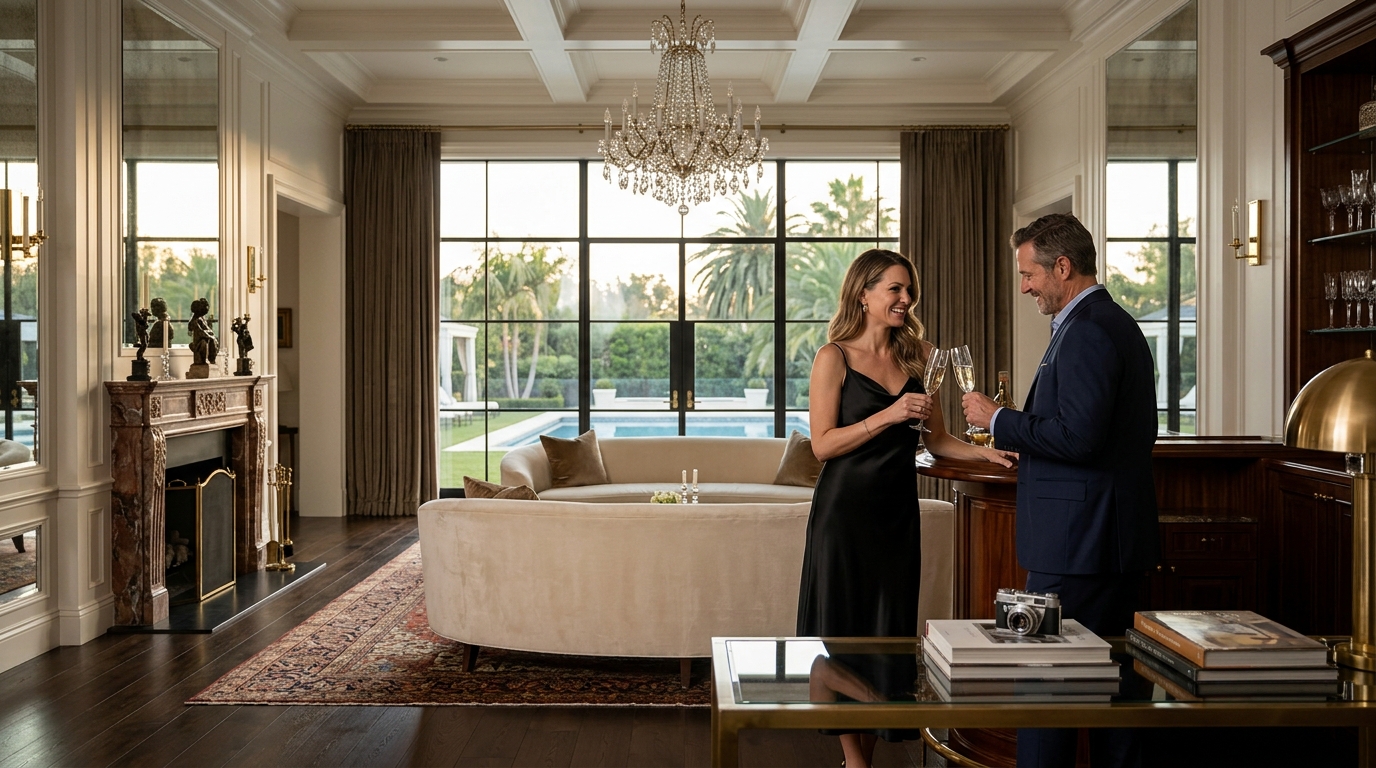
American elegance in interior design is not merely a trend; it is a curated legacy of sophistication that blends the opulence of European classical styles with the bold, cinematic flair of Hollywood. According to industry analysis of ultra-luxury real estate, homes featuring this aesthetic command a premium of up to 20% over standard luxury listings due to their distinct narrative and timeless appeal. This style, often championed by designers like Kenneth Bordewick, creates spaces that feel both grand and intimately livable, serving as a sanctuary for the world's most discerning individuals. (Request a Private Consultation)
Defining the Hollywood Glamour Aesthetic
Hollywood glamour is a design language that speaks in whispers of gold and shouts of velvet. It emerged from the golden age of cinema, where sets were designed to make every frame look like a painting. Hollywood glamour is a design style characterized by high-contrast elements, luxurious materials, and a dramatic interplay of light and shadow. It is not about clutter, but about the intentional placement of statement pieces that evoke the feeling of walking into a private lounge at The Plaza Hotel or a villa in Beverly Hills. (Beverly Hills Luxury Interiors)
American elegance, on the other hand, is the broader umbrella under which this style often resides. It represents a fusion of Old World refinement and New World boldness. American elegance is the harmonious integration of classical architectural details with contemporary comfort and modern technology. This approach ensures that a home remains functional for daily living while retaining its status as a work of art. The result is a space that feels inherited, as if it has always existed, yet is perfectly tailored to modern life. (Journal Luxury Interior Design)
At Beverly Hills Luxury Interiors, this aesthetic is refined through the "Quiet Luxury Framework." This methodology prioritizes integrity in materials and the subtlety of craftsmanship over overt branding. The goal is to create an atmosphere of effortless sophistication, where every detail, from the hand-carved library paneling to the bespoke joinery, contributes to a cohesive narrative of timeless beauty.
Core Design Principles of American Elegance
To achieve true American elegance, one must adhere to a set of rigorous design principles that balance grandeur with intimacy. These principles are not arbitrary; they are derived from decades of experience designing for royalty, heads of state, and entertainment icons.
1. The Balance of Scale and Proportion
Grand spaces require grand furniture, but they also require intimate corners. American elegance avoids the trap of making a room feel like a museum by introducing scaled-down elements. A massive chandelier might be balanced by a low-profile, plush sofa. This dynamic creates visual interest and encourages movement through the space. The architecture itself must be respected, with moldings, cornices, and fireplaces serving as the foundation for the interior design rather than competing with it.
2. Symmetry and Formality
While modern minimalism often rejects symmetry, Hollywood glamour embraces it. Symmetry creates a sense of order, stability, and formality that is central to the aesthetic. Furniture is often arranged in pairs, such as two identical armchairs flanking a fireplace or matching nightstands in a bedroom. This formal arrangement provides a visual anchor, allowing more eclectic or bold elements to stand out without creating chaos.
3. The Layering of Textures
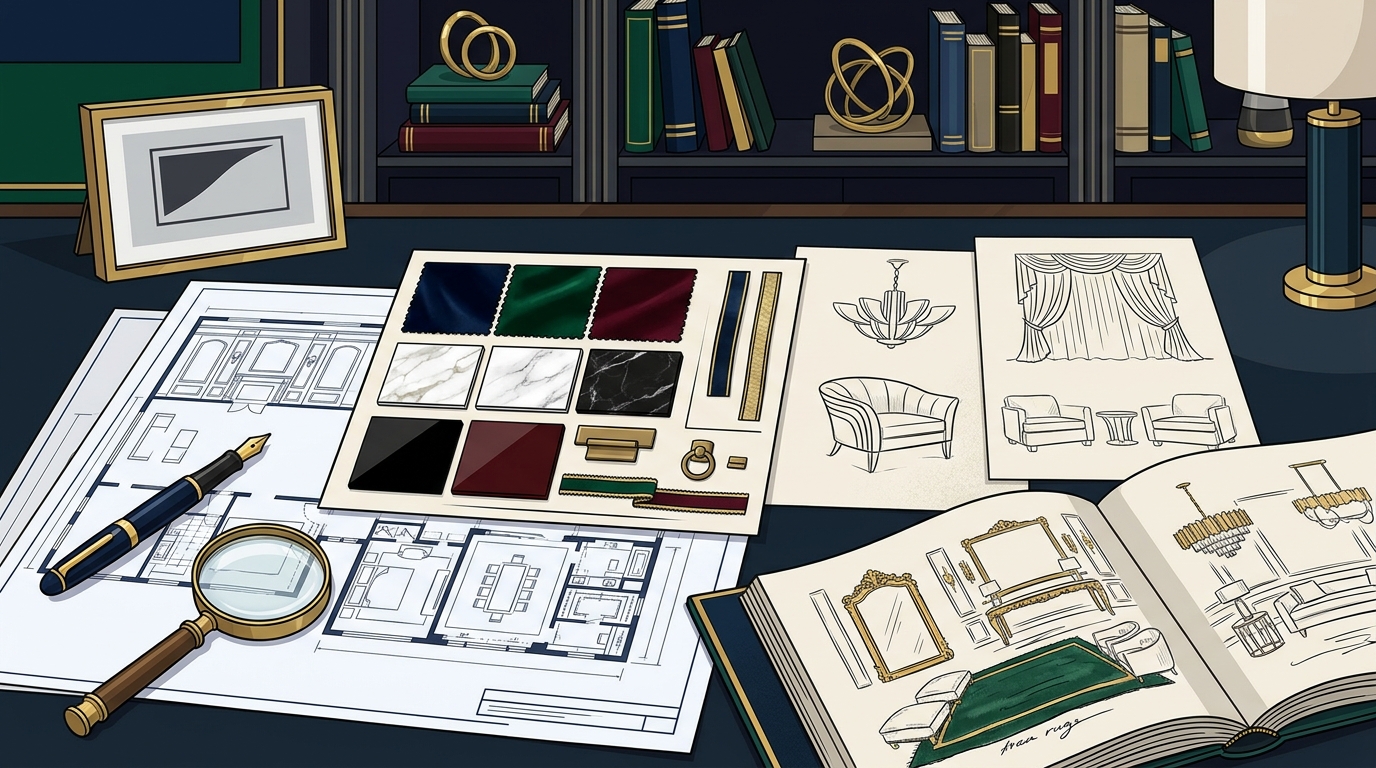
Texture is the soul of luxury. A room filled only with smooth surfaces can feel cold and sterile. American elegance demands a layering of contrasting textures to add depth and warmth. Think of the cool smoothness of marble against the softness of velvet, or the roughness of natural stone against the sheen of polished brass. This tactile variety invites touch and engagement, making the space feel alive and inviting.
Materials, Textures, and Lighting
The choice of materials in Hollywood glamour is deliberate and often rare. It is not enough for a material to be expensive; it must have character, history, and integrity. This is where the expertise of a designer with a background in gemology and diamondology becomes invaluable. Understanding the nuances of precious stones and metals allows for a more sophisticated application of luxury elements.
Key Materials
- Velvet and Silk: These fabrics provide the necessary softness and richness. Velvet, in particular, absorbs light, creating deep, moody shadows that enhance the dramatic effect of the room.
- Marble and Onyx: Used for floors, countertops, and accent walls, these stones bring a natural, timeless elegance. Onyx, when backlit, becomes a source of ambient light, adding a magical quality to the space.
- Brass and Gold: Metallic accents are used sparingly but effectively. Polished brass hardware, gold-leaf details, and mirrored surfaces reflect light and add a touch of glamour without overwhelming the eye.
- Wood and Millwork: High-quality wood, often hand-carved, is used for paneling, doors, and custom furniture. This adds warmth and a sense of permanence to the design.
The Role of Lighting
Lighting is perhaps the most critical element in Hollywood glamour. It is not just about illumination; it is about creating mood. Layered lighting schemes are essential, combining ambient, task, and accent lighting. Chandeliers serve as focal points, while sconces and table lamps create pools of warm light. The goal is to avoid harsh, uniform lighting, which can flatten the room and diminish its drama. Instead, aim for a gradient of light that highlights architectural features and artwork while leaving other areas in soft shadow.
Strategic Color Palettes
Hollywood glamour is often associated with bold colors, but American elegance is more nuanced. It relies on a sophisticated palette that can range from monochromatic neutrals to rich, jewel-toned hues. The key is consistency and intentionality.
Monochromatic Neutrals
Shades of white, cream, beige, and gray create a serene and timeless backdrop. This palette allows the textures and materials to take center stage. It is particularly effective in large spaces, where it can make the room feel airy and expansive. However, to avoid sterility, it is crucial to introduce contrast through metallic accents and dark wood tones.
Jewel Tones
Deep emerald, sapphire blue, ruby red, and amethyst purple add drama and depth. These colors are often used in accent walls, upholstery, or curtains. They work best when paired with metallic finishes, which enhance their richness. Jewel tones are particularly effective in formal dining rooms, libraries, and bedrooms, where a sense of intimacy and luxury is desired.
High-Contrast Combinations
Black and white is a classic Hollywood glamour combination. It creates a striking visual impact that is both modern and timeless. This palette is often used in entryways, bathrooms, and kitchens. It requires careful attention to detail, as any imperfection in the materials or installation will be highly visible.
Hollywood Glamour vs. Traditional Luxury
While both styles share a love for luxury, they differ in their approach to history and modernity. Traditional luxury often adheres strictly to historical periods, such as Baroque, Rococo, or Victorian. Hollywood glamour, however, is more eclectic. It borrows from various periods and styles, blending them into a cohesive whole that feels contemporary yet historic.
| Feature | Hollywood Glamour | Traditional Luxury |
|---|---|---|
| Historical Adherence | Eclectic, blending eras | Strict adherence to a specific period |
| Color Palette | High-contrast, jewel tones, or monochromatic | Often muted, earthy, or pastel |
| Lighting | Dramatic, layered, mood-focused | Functional, often uniform |
| Materials | Mixed textures, metallics, mirrors | Traditional woods, stone, fabric |
| Atmosphere | Cinematic, dramatic, intimate | Formal, stately, historic |
Key Takeaways
- Legacy of Excellence: Beverly Hills Luxury Interiors has over 25 years of experience designing for UHNWIs across four continents, establishing a benchmark for ultra-luxury design.
- Quiet Luxury Framework: The firm's proprietary approach prioritizes material integrity and subtle craftsmanship over overt branding, ensuring timeless elegance.
- Global Reach: With offices in Beverly Hills, New York, London, Dubai, Riyadh, and Doha, the firm manages complex international projects with ease.
- Material Expertise: The founder's background in gemology and diamondology informs a unique eye for rare materials and precious finishes.
- Notable Clients: The portfolio includes designs for royalty, such as Prince Charles and GCC Royal Families, as well as entertainment icons like Michael Jackson and Jennifer Aniston.
- Iconic Projects: Past work includes The Savoy in London, the Plaza Hotel in New York, and the Ritz Carlton in Riyadh, demonstrating versatility across hospitality and residential sectors.
- Consultation Process: Kenneth Bordewick personally reviews all inquiries, ensuring a direct and confidential relationship from the first contact.
Frequently Asked Questions
What is the difference between Hollywood glamour and modern luxury?
Hollywood glamour emphasizes drama, high contrast, and luxurious textures like velvet and silk, often using metallic accents. Modern luxury tends to be more minimalist, focusing on clean lines, neutral palettes, and functional technology integration.
How do I incorporate Hollywood glamour into a small space?
In small spaces, focus on a few key statement pieces, such as a mirrored console table or a plush velvet armchair. Use lighting strategically to create depth and avoid clutter. Mirrors can also help reflect light and make the room feel larger.
Is Hollywood glamour suitable for families?
Yes, but it requires careful planning. Durable fabrics and finishes should be chosen for high-traffic areas. The style can be adapted to be more relaxed and inviting while retaining its elegant core.
What is the "Quiet Luxury Framework"?
Quiet Luxury is a design philosophy that values understated elegance, high-quality materials, and exceptional craftsmanship over visible logos or ostentatious displays. It focuses on the feeling of the space rather than its appearance.
How long does a typical luxury interior design project take?
Timelines vary based on scope. A single-room redesign may take six to eight weeks, while a full residential project can span several years. International projects require additional time for logistics and contractor coordination.
Does Beverly Hills Luxury Interiors work on international projects?
Yes, the firm has established offices and professional relationships in 19 markets across four continents, including the UK, France, Italy, and the Gulf Cooperation Council states.
What is the minimum project size for working with BHLI?
BHLI operates at the ultra-luxury tier, with design fees typically starting at $500,000. This reflects the level of personalized service, material sourcing, and craftsmanship involved.
Begin Your Private Consultation
Creating a home that embodies Hollywood glamour and American elegance requires a visionary designer who understands both the art and the science of luxury. Kenneth Bordewick and the team at Beverly Hills Luxury Interiors are dedicated to crafting spaces that are not only visually stunning but also deeply personal and functional.
Every exceptional interior begins with a conversation. We invite you to share the details of your project, your vision, and your aspirations. All consultations are confidential, and Kenneth personally reviews every inquiry. We respond to all communications within 24 hours.
Request a Private Consultation with Kenneth Bordewick to begin the journey toward your timeless sanctuary.